▷
New to options?
Start in paper mode with sensible defaults. Every proposed trade arrives as an approval card that explains the setup, the credit, and the exact maximum loss before you tap approve. Nothing is ever placed without your say-so. You learn the discipline by watching it work.
≡
Seasoned executor?
Every parameter is a dial you own: delta band, credit and width floors, daily risk budget, earnings blackouts, and how much, if anything, the agent may submit without asking. Hands-off execution requires a typed authorization, and a full decision journal records why every entry and exit happened.
⚖
Either way, the balancer keeps you honest
Whatever you choose, it watches the whole book, not just the trade in front of you: beta-weighted delta against SPY, directional risk capped against theta income, and bias pairing that pulls a tilted book back toward neutral. Individual trades can be opinions. The portfolio stays disciplined.
AI Conviction Scoring
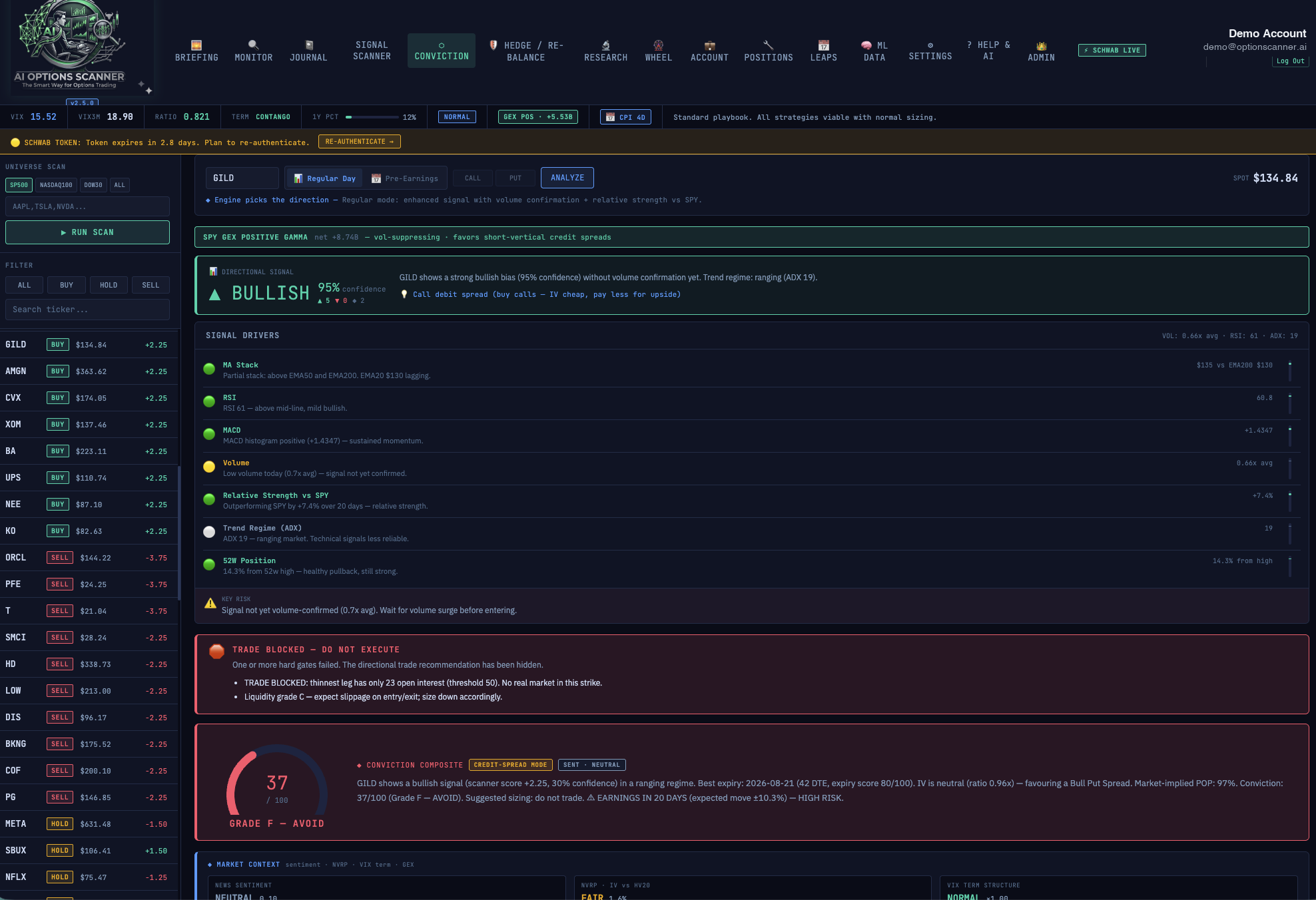
A single calibrated score per ticker, blending directional bias, news sentiment, and options-flow positioning into one number you can act on.
Live Position Monitor
Every open position pulled live from your connected brokers and auto-flagged CLOSE, ROLL, TAKE PROFIT, or STAY. No more scrolling the chain by hand.
Auto Tech Chart Analysis
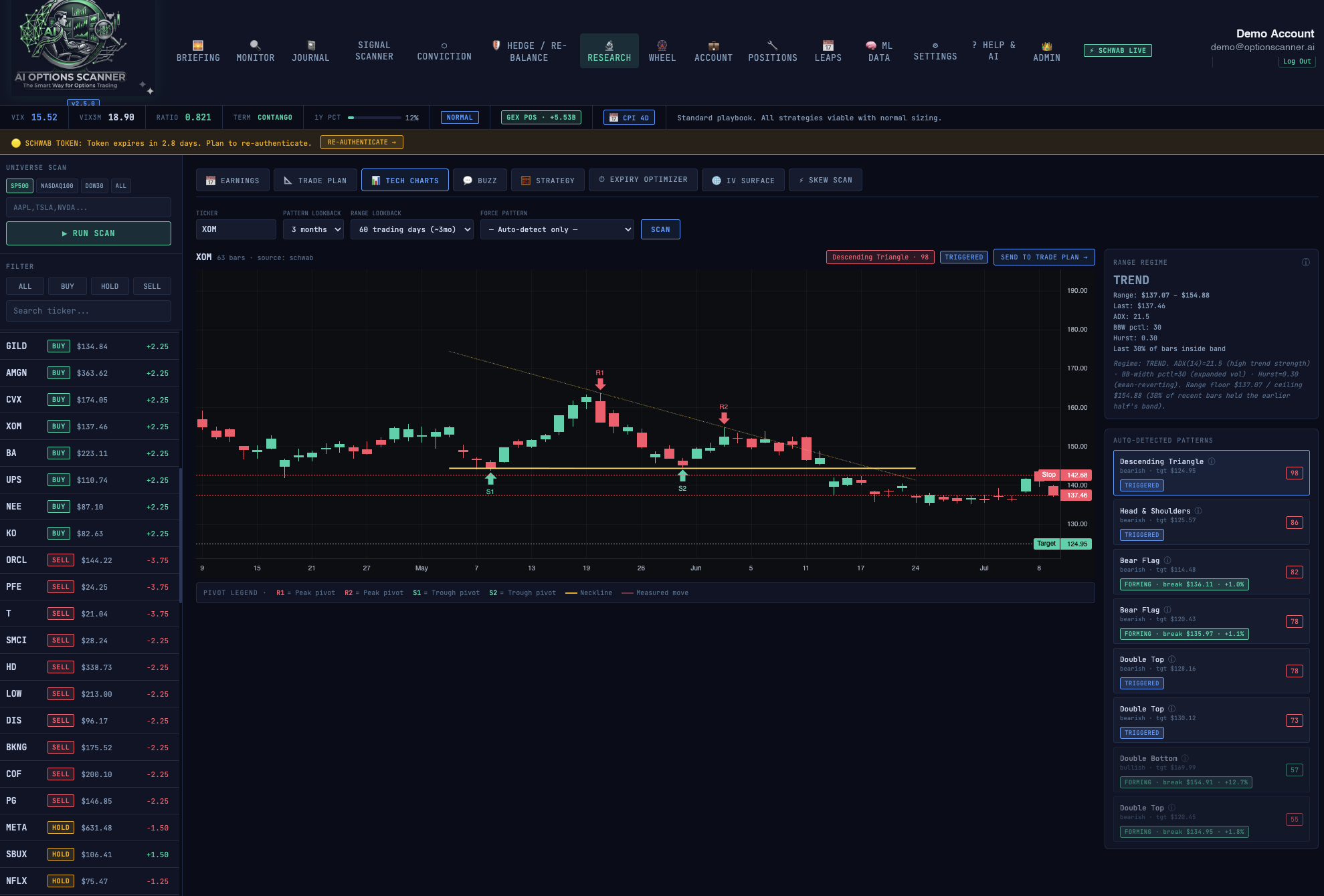
Every candle scanned for flags, triangles, double tops and bottoms, and head-and-shoulders the moment a pattern completes, scored and ready to act on.
Trade Plan Builder
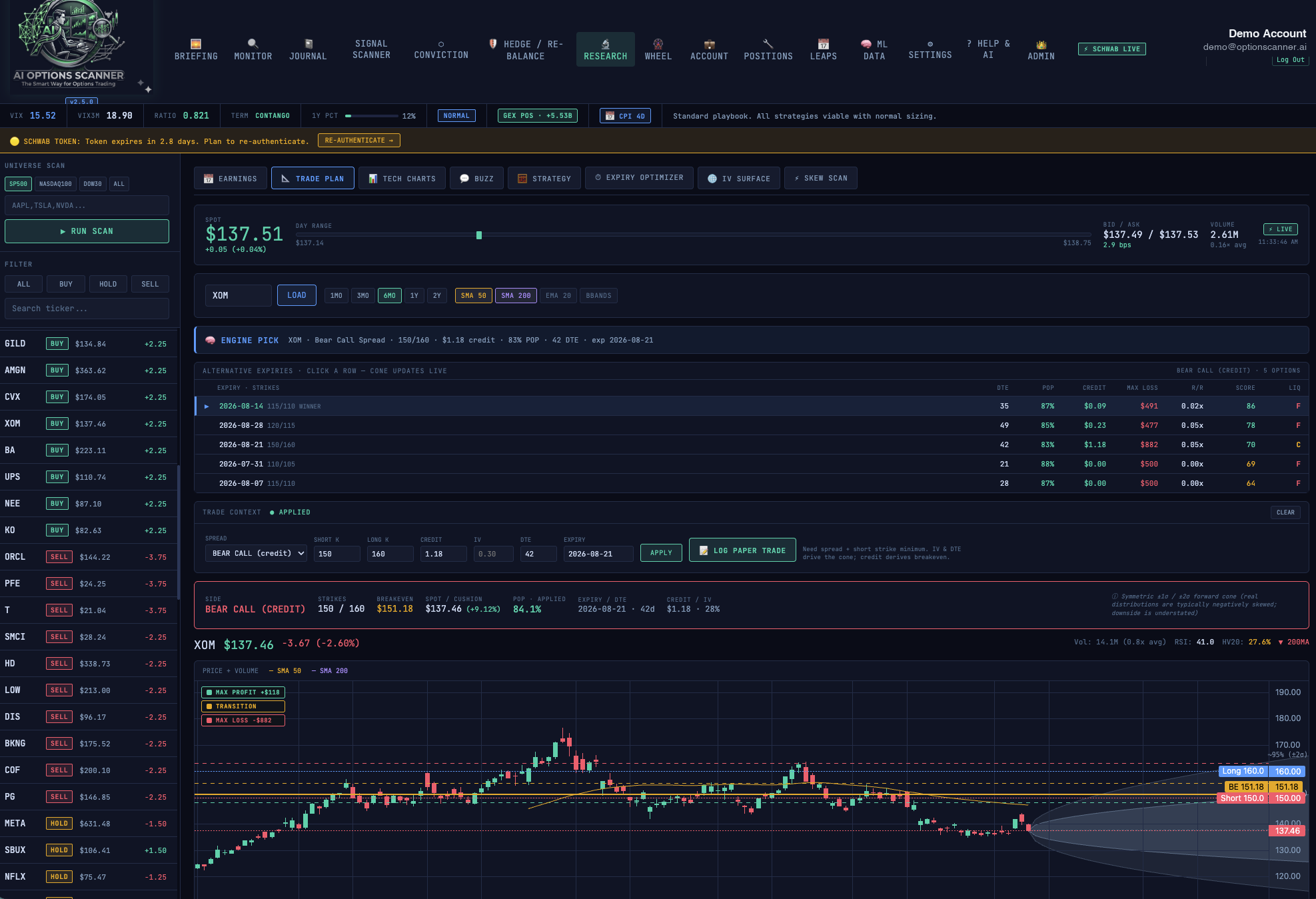
Turn any signal, pattern, or conviction score into strikes, expiry, POP, and a breakeven cone, before you place a single order.
Trade Journal & P&L
Every trade auto-classified by strategy, with live P&L and effectiveness broken down by source, grade, and ticker.
AI Research Assistant
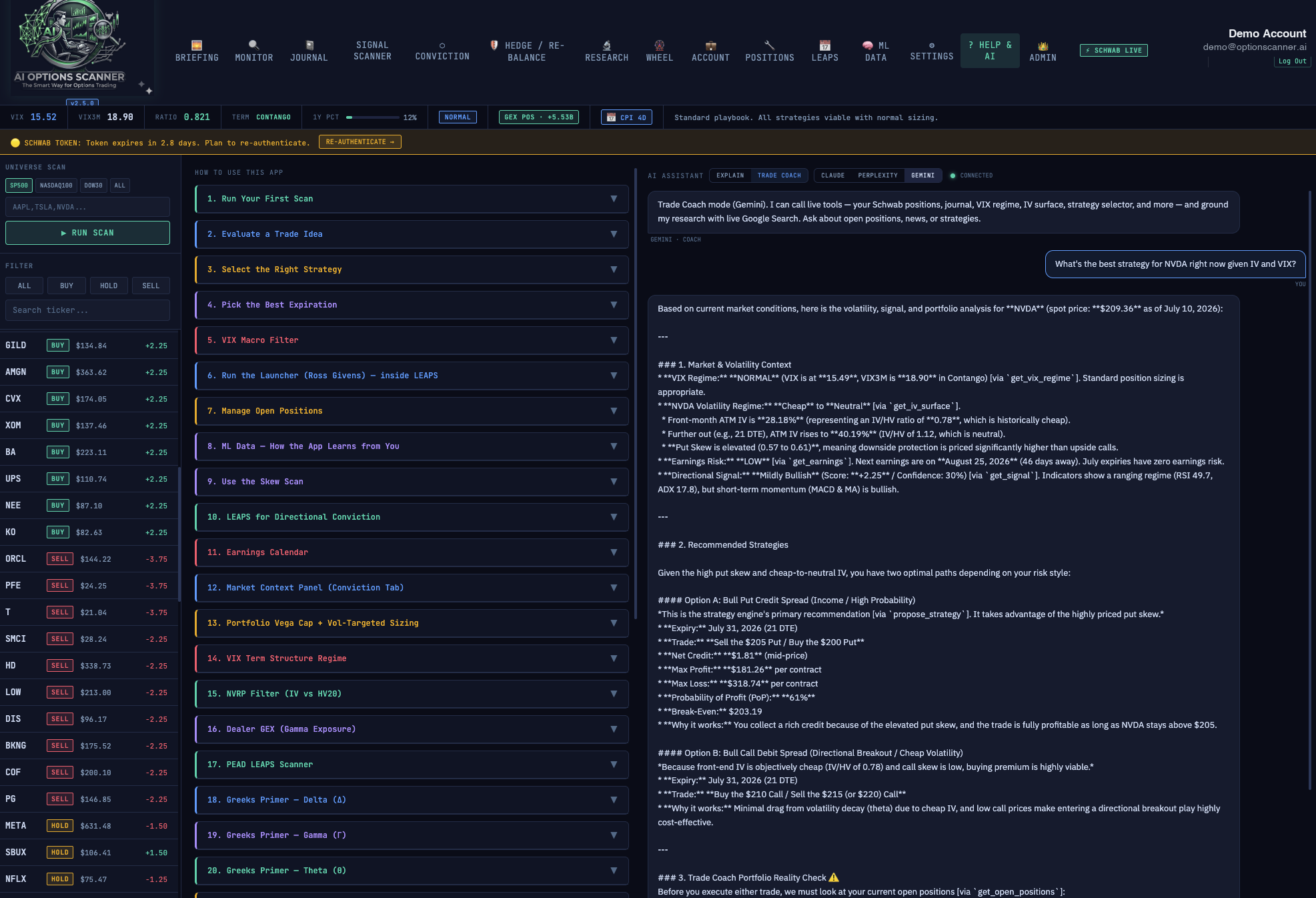
Ask about your account in plain English, like "what's my riskiest position this week?", and get an answer grounded in your real data.
ML Pattern Engine
A model trains on your own closed trades, learning which setups actually worked for you, then feeds calibrated probabilities back into every conviction score.
SELF-LEARNING
FAQ
How it thinks, in plain English.
The short version: deterministic rules decide, AI explains.
Is my brokerage account data stored on your servers?
No. Your positions, balances, and order history live at your brokerage and stay there. When the platform reports that a position has crossed one of the exit rules you configured, that reading is computed in the moment from your broker's live feed and shown to you, not saved: nothing account-specific is written to our database. The only trading records the platform keeps are the ones it creates itself, your paper-trading journal and the sandbox agent's decision log, so the discipline can learn from its own history without ever warehousing yours. Disconnect your broker and there is no account data left behind, because none was stored in the first place.
What does Options Scanner actually do?
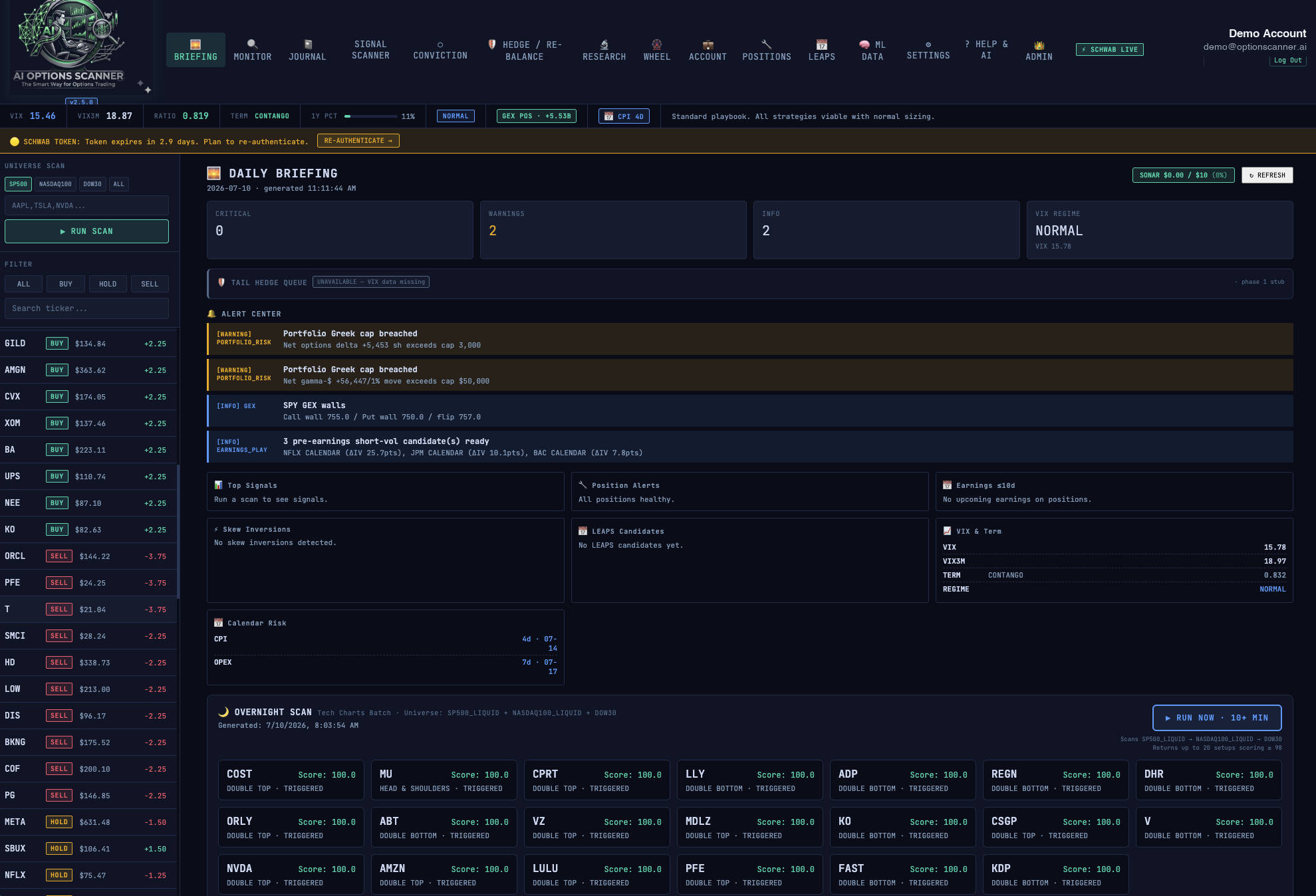
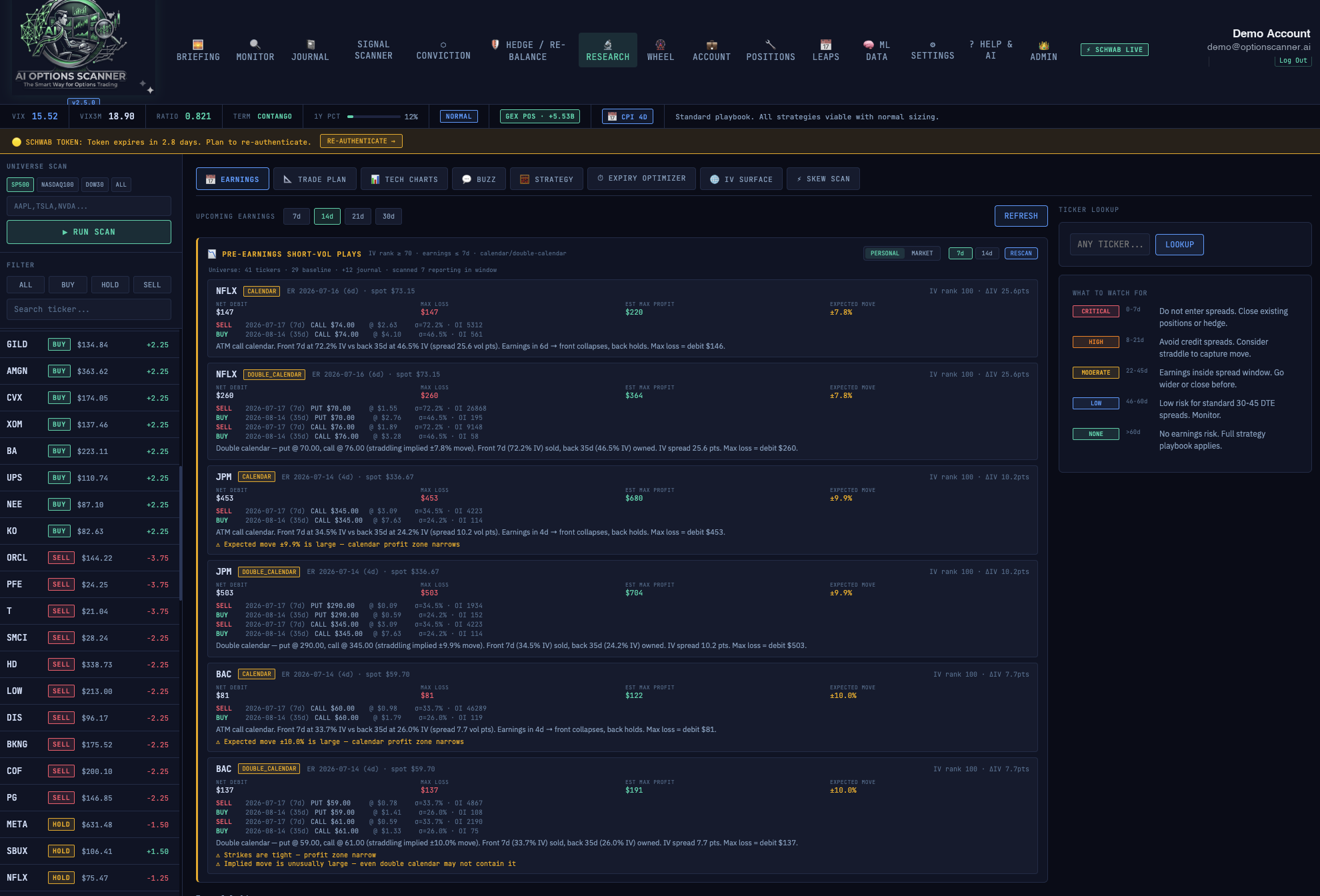
It is a full options desk in one dashboard. A morning scanner ranks your universe by signal strength and IV rank. A conviction engine scores every ticker with the drivers shown. A trade plan builder turns any signal into strikes, expiry, probability of profit, and a breakeven cone. A live monitor watches every open position and flags hold, roll, take profit, or close. A journal auto-classifies every trade and tracks what actually works for you. And an AI assistant sits on top of all of it to explain anything on screen in plain English.
Which brokers do you support?
Schwab, Tradier, and Alpaca today, with additional brokers planned as part of the future roadmap. Schwab powers real-time market data, Tradier and Alpaca handle API-based order execution, and Alpaca can also supply real-time options data through your own Alpaca data subscription. You can start with any one of them; connecting more unlocks the full experience.
Will the agent trade without me?
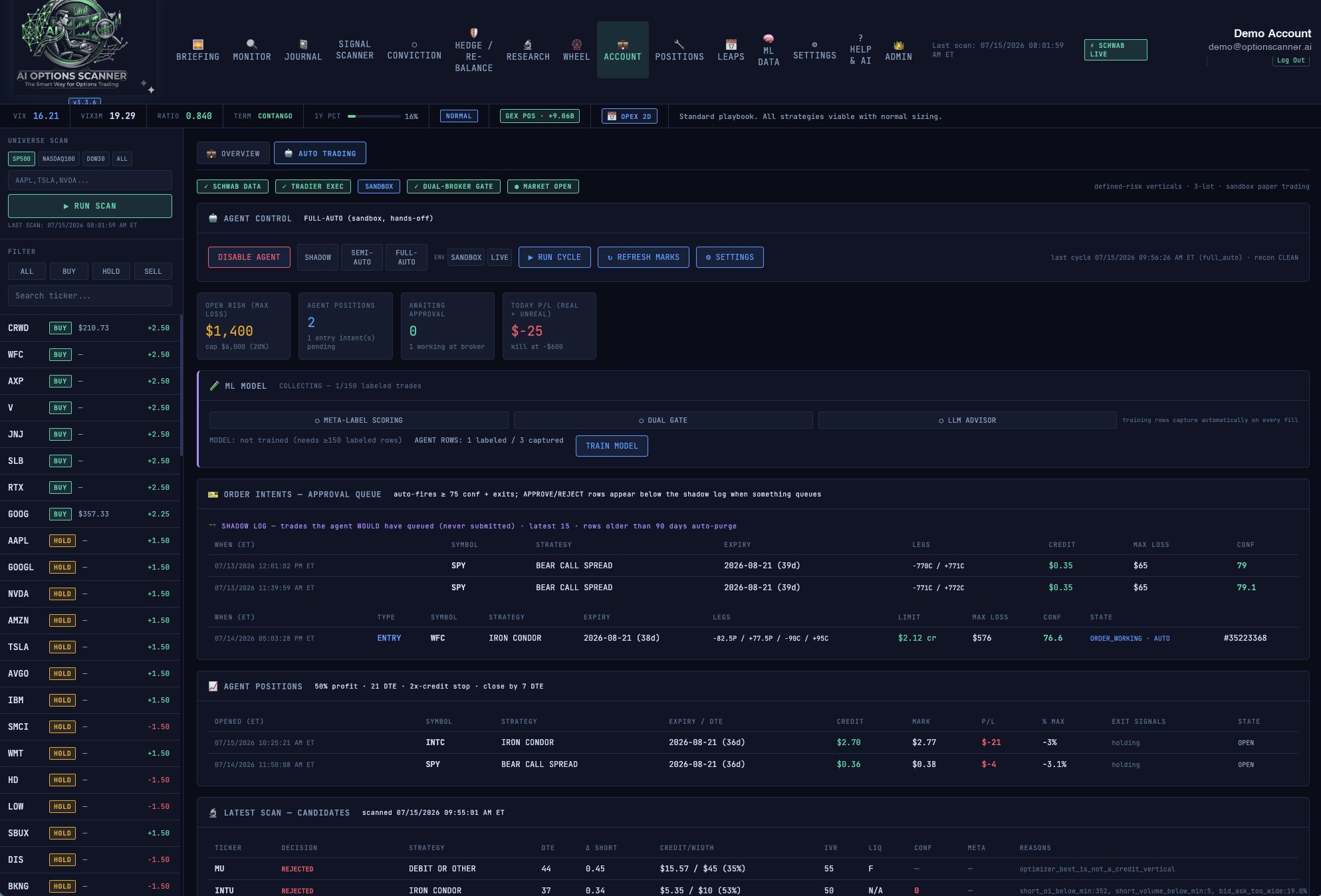
Not unless you explicitly tell it to. The default mode proposes trades and waits for your approval. If you want hands-off execution you set a per-trade limit and type an authorization to enable it, and even then the balancer's caps and your daily risk budget still apply. A kill switch stops everything instantly.
I don't have a brokerage account. Should I still request access?
No. A brokerage account with options trading enabled is the one minimum requirement. Skill level is not: the tool is built to assist you whether you are placing your first spread or your thousandth.
Who makes the trading decisions, the AI or the rules?
The rules. Every signal, entry filter, and risk cap comes from a deterministic rules engine built on long-standing options industry practice: defined-risk structures only, 30 to 45 days to expiry, short strikes inside a disciplined delta band, IV rank floors so premium is only sold when it is rich, liquidity minimums on open interest and bid-ask width, credit-to-width floors, and position sizing computed from worst-case loss. The same inputs always produce the same outputs. The AI cannot override, loosen, or talk its way past a single one of them.
So where does the AI come in?
In two places, both deliberately bounded. Inside the engine it is secondary guidance: an AI perspective that reviews what the rules already scored, adds market context, and never changes the math. Where it truly shines is the Help & AI section: a research assistant with more than twenty live tools that reads your actual positions, explains every measure and factor in the app, and answers account-specific questions like "what is my riskiest position this week" or "why was that spread rejected."
Can it manage the whole portfolio, not just single trades?
The auto trading agent now manages the book, not just the trade. Every position is beta-weighted against SPY, and three deterministic gates keep the portfolio balanced: directional exposure must stay proportional to daily theta income, is hard-capped as a fraction of capital, and when the book tilts too far, the agent will only accept trades that pull it back toward equilibrium. Every rejected candidate is logged with its exact reason, and a built-in AI analyst explains the aggregate picture in plain English.
Do I need my own AI API keys?
No. The AI features, the coach, second opinions, and catalyst research, run on keys the platform manages and are included in the subscription. The one exception is the optional voice avatar, which renders through Anam, a third-party service, using your own Anam API key; Anam's most basic plan, currently $12.99 a month, is enough. If you prefer to run the other AI features on your own Gemini or Anthropic keys you still can, from Settings, and then that spend is yours.
How do I know an AI answer is real and not made up?
Grounding is enforced, not promised. Every number the assistant states must come from a live tool call against your account or market data inside that same conversation, and it cites the tool it used inline. The server independently checks each reply against the tools that actually ran. If the assistant cannot ground an answer, it says "I need to run the tools for that" instead of guessing.
What does explainability mean in practice?
Ask why your conviction score is an 87 and you get the real subscores that built it. Ask why the engine rejected a trade idea and you get the exact filter that failed and the number it failed by, read from the record the engine wrote at decision time. Nothing is reconstructed after the fact and no rationale is invented to sound plausible. Every measure, factor, and account-specific decision in the app can be traced to its logged reasons.
Can it place trades for me?
Not with real money without you. A research agent can paper-trade the rules discipline in a sandbox so you can watch the process work risk-free. Anything touching a real account requires your explicit review and approval on every single order. The AI can analyze, propose, and queue an idea for your review. Only you can execute.
Whose market data is this?
Yours. You connect your own Schwab and/or Tradier account with a one-time OAuth login, or your Alpaca account with API keys you create in your Alpaca dashboard, and the platform works from your broker's real-time feed. OAuth passwords never touch our servers, Alpaca API keys are stored encrypted and can be revoked by you at Alpaca at any time, nothing is resold, and you never pay twice for data you already have.
What happens if my broker feed or OAuth token breaks?
Brokers expire access on their own schedules, and the app is built to make that painless. Schwab enforces a strict 7 day re-authentication; we have simplified it to an in-app flow that takes about 30 seconds, and the app notifies you as the token approaches expiration. Tradier and Alpaca use long-lived API keys instead, so there is nothing to renew unless you decide to rotate or revoke your keys from your broker's dashboard.
What does Options Scanner cost?
One plan: $99 a month, and your first 30 days are free. Everything is included, the scanner, conviction scoring, trade plans, live monitoring, the auto trading agent, the journal, and the AI features, with no separate tiers or AI add-on charges. You can cancel anytime, and monitoring and exits on your open positions are never locked, even if your subscription lapses. Live trading uses your own brokerage account, and real-time options data may require a market-data subscription with your brokerage, billed by them, not us.
Can I backtest strategies like on other options platforms?
No, by design. Backtests validate a recipe against history, and history is where overfitting hides. Options Scanner measures forward instead: the desk runs the full discipline on paper with live quotes and realistic fill modeling, and the platform publishes its own honest bookkeeping, calibration of its scores against actual outcomes, slippage between modeled and real fills, and exit-reason attribution. You judge the desk by watching it work under today's market, not a curve fit to yesterday's. Educational tool; not investment advice; past or simulated performance does not predict future results.
Is this financial advice?
No. Options Scanner is an analysis tool operated by Avenix Solutions LLC, not a registered investment advisor. Signals and scores come from rule-based and statistical analysis of public market data plus your own account information. Every trade is your decision and your responsibility.